Okuma görünümü

Why Modern Enterprises Hire AI Developers to Power Smarter Digital Transformation

Bringing Together Practical Real World AI Architectures, AI Engineer Skill Sets, And Cost Of AI Development Within Industries

Summary: Most companies within the UK are walking towards further innovation, but many digital initiatives are not growing to the level they deserve because they have limited AI skills and experience. Hire ai developers to develop intelligent systems that are compatible with their existing systems, a business can scale quickly and effectively. This post represents a way to understand how AI engineers build secure, scalable, and real-world-ready solutions.

In addition, this post provides an overview of where technical leaders can benefit from long-term value through AI vs. short-term experimentation. Such as architecture options, deployment challenges, and additional factors related to costs for AI. Development systems.

Introduction

Digital transformation used to be about moving to the cloud and automating tasks. Now, it’s about making systems think. To stay competitive, companies must build tools that are predictive and responsive, not just functional.

This shift is why forward-thinking leaders now hire AI developers over traditional teams alone. True digital transformation requires more than just code; it demands an understanding of data pipelines and model behavior to move past the “proof of concept” phase. Here is how AI experts are turning complex data into the reliable, intelligent systems driving today’s enterprise-grade outcomes.

The Practical Role of AI Developers in Enterprise Systems

The responsibilities of AI developers are relatively distinct from those of traditional applications engineers. The AI developer’s primary role is to help define how an AI application moves and learns, as opposed to simply developing code for these applications.

In general, AI developers perform many of these same tasks on a daily basis, including:

  1. Preparing and validating large datasets to be used during training and inference.
  2. Selecting models that provide an appropriate balance between accuracy, performance, and explainability.
  3. Launching AI models in a production environment using API and microservices.

Experienced teams working with an established AI development company follow structured engineering practices rather than experimental shortcuts. This ensures models perform consistently under real-world conditions and can be maintained as business requirements change.

AI Architecture Decisions That Enable Digital Transformation

Architecture is where many AI projects succeed or fail. Poor design choices often lead to high costs and limited scalability.

Common enterprise AI architectures include:

  • Cloud-native model services for scalable workloads
  • Edge-based inference for low-latency industrial systems
  • Hybrid environments combining on-premise data with cloud processing

AI developers assess latency requirements, data sensitivity, and operational costs before selecting an approach. These actions provide the foundation for organisations to achieve sustainable digital transformation by enabling their AI systems to scale past simply being an isolated tool within the business.

How AI Engineers Add Value to Each Industry

Every industry leverages its own set of value drivers when it comes to generating revenue through AI. Its impact depends on how well solutions align with industry workflows.

Examples include:

  • Healthcare teams building diagnostic support systems using image analysis
  • Financial platforms deploying real-time fraud detection models
  • Retail organisations are improving demand forecasting and inventory planning
  • Manufacturers use computer vision to ensure quality

In many cases, companies choose to hire dedicated engineers who understand both the industry context and the technical stack. This long-term collaboration results in systems that improve continuously instead of remaining static deployments.

Breaking Down the Cost of AI Development

The cost of AI development is often misunderstood. It extends far beyond training a model.

Key contributors include:

  1. Data preparation and cleaning efforts
  2. Infrastructure and compute usage
  3. API Integration / Integration Solution
  4. Continuous monitoring, training, and optimizing of AI Models

Many companies focus primarily on developing the application when they build an AI application, which often leads to a delay in any future improvements after launch. Partnering with an established AI development company will provide your team with a solid foundation for understanding the expenses incurred in connection with the project and how to link AI investments to actual business outcomes.

AI Security, Compliance, and Responsible Development

AI Systems deal with Sensitive Data and have a Major Impact on decision-making. Security and Compliance should always be part of the Engineering Process rather than added later.

Here are some Best Practices for AI:

  • Encrypted data pipelines
  • Access controls for models and datasets
  • Bias testing and explainability tools
  • Compliance with UK and EU data protection standards

AI developers build these safeguards into system design. By implementing Responsible AI practices, organizations and their users will benefit from increased trust and protection associated with intelligent systems.

Final thoughts

The results of Digital Platforms will hinge on the organisation’s ability to utilise Artificial Intelligence (AI) effectively. What differentiates companies that do well with their use of AI vs. those who struggle is the ability to hire AI developers. Qualified Artificial Intelligence development professionals can help businesses create quality architecture for AI and also assist the organisation with the true cost of AI development. Ultimately, qualified Artificial Intelligence developers will be an invaluable part of an organisation’s strategy to grow its business by using AI technology rather than treating it as a risky, untested product.

Author Bio: 

Alex Martin is a Content Manager at HData Systems, creating clear, engaging, and SEO-focused content that supports brand growth. He turns complex business and technology insights into impactful messaging that builds trust, increases visibility, and promotes scalable digital solutions.

  •  

Top 10 AI Healthcare Software Development Companies in 2026

Healthcare organizations are utilizing artificial intelligence (AI), providing healthcare providers an opportunity to use AI to assist in obtaining medical diagnostics, documenting patient information, predicting patient needs and maximizing provider workflow processes. By 2026, AI has transitioned from a phase of exploring or experimenting with the technology as an option for the industry to the phase of becoming a regulated and deployed solution that is fully established as a part of the healthcare market.

AI has established a new norm for health care systems as there is an expectation of integration with existing systems as well as strict compliance to data protection rules and guidelines while also being able to deliver measurable results. This has made the decision to choose a partner in your development process of AI a strategic one at this time. These biomedical engineers are companies that stand out as the top ten in 2026 for their proven history of success in delivering a product for the AI healthcare software systems.

How these companies were selected

The companies on this list were assessed according to the following criteria:

  • Hands-on experience with AI/healthcare software
  • Knowledge of healthcare regulations (HIPAA, GDPR, Dual Use Regulation – D=Referencing or Replicating Federal Guidance for Developmental Clinical and Marketing Requirements); 
  • Ability to integrate AI into Electronic Health Records (EHRs) and other hospital information systems 
  • Implementation of transparent delivery processes and providing long-term support 
  • Verified client reviews from actual implementations; industry recognition.

The focus was on vendors that are utilizing true deployments of real-world AI in their healthcare solutions rather than those that are simply experimenting or solely conducting research.

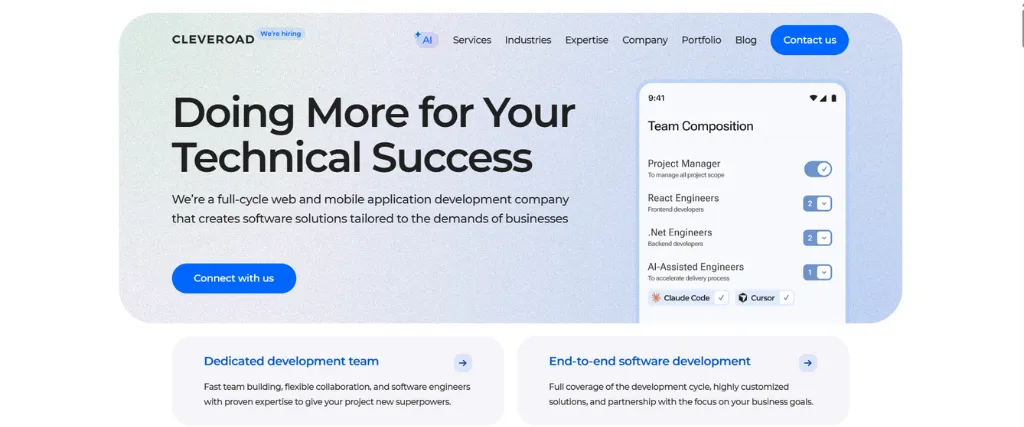
1. Cleveroad

Founded in: 2011
Headquarters: Claymont, Delaware, USA
Hourly Rate: $50–$80
Industry Expertise: Healthcare, Fintech, Logistics, Retail, Media, eCommerce
Reviews: 70+ reviews on Clutch, average rating 4.9/5
Website: cleveroad.com

Cleveroad is an established healthcare software development company specializing in AI-driven solutions for medical providers, digital health start-ups, and healthcare organizations across the United States and Europe. With over a decade of development experience, the company creates, implements, and supports secure, scalable platforms that use artificial intelligence in clinical and operational workflows. With over a decade of development experience, we create, implement, and support secure, scalable platforms that can utilize AI as part of their workflows in clinical and operational environments.

At Cleveroad, we focus on providing expertise in utilizing AI for healthcare systems that are: telemedicine (telehealth) systems; Patient Engagement Platforms; Clinical Data Analytics; Decision Support Tools; and Understanding/Finding Interoperability between various healthcare-related systems using HL7 and FHIR standards of interoperability for integration of Electronic Health Records (EHRs) with hospitals, etc.

Cleveroad is IEEE 27001 and 9001-certified and a partner at the AWS Select Tier level. As a company, we believe that the best way to develop a system using AI technology is by incorporating the input of doctors and clinicians (Human-in-the-Loop). With this design approach, we develop new AI/healthcare solutions that will support clinicians in their delivery of quality patient care by improving the buy-in of the new solutions to achieve alignment with healthcare governance requirements.

2. ScienceSoft

Founded in: 1989
Headquarters: McKinney, Texas, USA
Hourly Rate: $50–$100
Industry Expertise: Healthcare, Manufacturing, Banking, Retail
Reviews: 60+ reviews on Clutch, average rating 4.8/5
Website: scnsoft.com

ScienceSoft is a well-established IT consulting and software development firm focusing on providing solutions based on Artificial Intelligence to support the Health Care community. The company offers to Health Care Providers, Pharmaceutical Organizations and Medical Services Companies

AI-Based Analytics Platforms, Predictive Model Solution and Clinical Data Management Systems that enable Health Care Organizations to enhance their Planning, Diagnostics and Operational Efficiency while emphasizing Data Security and adhering to Regulatory Compliance.

As ScienceSoft continues to be in business for many years, it has built a reputation for providing Enterprise-Grade Delivery and Long-term Support for Applications.

3. Itransition

Founded in: 1998
Headquarters: Denver, Colorado, USA
Hourly Rate: $40–$90
Industry Expertise: Healthcare, Automotive, Telecom, Finance
Reviews: 40+ reviews on Clutch, average rating 4.9/5
Website: itransition.com

Itransition is an AI healthcare software development service company that helps organizations develop the most complex, integrated healthcare systems with the most flexible architectures. It provides services to healthcare providers, insurance companies, and digital health platforms.

Itransition’s AI Healthtech Service includes Patient Engagement Systems, Diagnostic Support Tools, and Intelligent Administrative Automation Platforms. Itransition typically provides support for multi-system environments in which an AI must interact with numerous distributed and fragmented sources of healthcare data.

Itransition is well-positioned to serve large and mid-sized Healthcare Ecosystems.

4. Netguru

Founded in: 2008
Headquarters: Poznań, Poland
Hourly Rate: $60–$120
Industry Expertise: Healthcare, Fintech, Education, SaaS
Reviews: 80+ reviews on Clutch, average rating 4.8/5
Website: netguru.com

Netguru has a focus on usability and patient experience, so they are focused on developing AI-powered Digital Health Products. They also regularly include partnerships with healthcare startups and Payer/Provider Innovations Teams.

Netguru Health AI technology includes Chatbots, Remote Monitoring Products and Mobile Health Platforms. Additionally, they place a strong emphasis on Product-Cycle Speed and Development towards Products.

Therefore, this approach is suitable for organizations whose primary focus is on the quickness of getting Products onto the “shelves” or into the hands of users while maintaining user engagement with the Product once it becomes available.

5. InData Labs

Founded in: 2014
Headquarters: Limassol, Cyprus
Hourly Rate: $60–$100
Industry Expertise: Healthcare, Marketing, Finance
Reviews: 30+ reviews on Clutch, average rating 4.9/5
Website: indatalabs.com

InData Labs is a company that specializes in data science and machine learning, and it provides services related to AI for healthcare analytics and predictive modeling. The company collaborates with healthcare and healthtech businesses which are dependent on data-heavy systems.

The company’s specialties consist of handling elaborated medical data, developing risk assessment models, and providing the so-called AI-driven insights for

InData Labs is an ideal partner for healthcare projects with complex data needs.

6. ELEKS

Founded in: 1991
Headquarters: Tallinn, Estonia
Hourly Rate: $50–$100
Industry Expertise: Healthcare, Energy, Logistics, Finance
Reviews: 50+ reviews on Clutch, average rating 4.8/5
Website: eleks.com

ELEKS develops high-quality healthcare AI software specifically serving large businesses and Health Networks, enabling customers’ ability to leverage powerful analytics tools and clinical dashboards to manage their operations with ease.

As part of an ongoing digital transformation strategy,ELEKS’ healthcare AI solutions offer a firm foundation through seamless integration into an existing unstructured data infrastructure with an emphasis on security and scalability – all.

When implemented in larger and more advanced operations, ELEKS has proven to be a suitable candidate for complex enterprise-grade healthcare models within the United States market.

7. Softermii

Founded in: 2014
Headquarters: Los Angeles, California, USA
Hourly Rate: $45–$90
Industry Expertise: Healthcare, Fintech, On-demand services
Reviews: 25+ reviews on Clutch, average rating 4.8/5
Website: softermii.com

Softermii creates applications by using Artificial intelligence for Healthcare purposes. Their primary focus is to help companies develop applications and systems in the areas of telemedicine and Patient interactions. The company partners with both startup and mid-sized health providers.

Some examples of the products and services offered by Softermii are: AI-enabled scheduling systems, patient communications tools, and telehealth platforms. They place strong emphasis on developing rapid validation and delivering a highly scalable product.

8. Intellectsoft

Founded in: 2007
Headquarters: New York, USA
Hourly Rate: $70–$150
Industry Expertise: Healthcare, Construction, Retail
Reviews: 40+ reviews on Clutch, average rating 4.7/5
Website: intellectsoft.net

Intellectsoft offers AI-based software development services for hospitals and large enterprises. Intellectsoft also supports the Migration of legacy systems, Automated workflows and AI Driven Analytics. Intellectsoft has experience developing, deploying and maintaining complex Digital Transformational Projects in regulated environments.

9. SparxIT

Founded in: 2007
Headquarters: Noida, India
Hourly Rate: $30–$70
Industry Expertise: Healthcare, eCommerce, Education
Reviews: 35+ reviews on Clutch, average rating 4.6/5
Website: sparxitsolutions.com

SparxIT specializes in developing healthcare systems and applications. They do this by utilizing artificial intelligence-based technologies at competitive rates. They offer a range of solutions to customers, including: Patient Portals, AI Chatbots, and Visual Data Analytics Tools.

SparxIT’s business model is especially suited to healthcare projects that have defined budgets and scope.

10. MindInventory

Founded in: 2011
Headquarters: Ahmedabad, India
Hourly Rate: $25–$60
Industry Expertise: Healthcare, IoT, SaaS
Reviews: 30+ reviews on Clutch, average rating 4.7/5
Website: mindinventory.com

The AI healthcare solutions from MindInventory include chatbots, symptom checkers, and mobile health applications. MindInventory collaborates regularly with early-stage healthtech startups to build their products.

The focus of MindInventory’s work in AI healthcare solutions is to create lightweight AI features that enhance patient engagement and accessibility.

Final thoughts

Developing AI-based healthcare software in 2026 involves much more than just IT capabilities. Healthcare organizations will need to consider all three areas, regulatory compliance, clinical alignment, and long-term sustainable delivery capability, when selecting a vendor for software development.

The vendors listed above demonstrate how some of them are capable of supporting enterprise scale projects, while others have the agility associated with a smaller startup. Choosing the right vendor will be dependent on a healthcare organization’s project size and scope, as well as their compliance needs, and overall digital health strategy for the future.

Related Article: Why Modern Enterprises Hire AI Developers to Power Smarter Digital Transformation

  •  

Top-3 AI Use Cases in the FinTech Industry

The rise of FinTech has created conditions for bursts of innovation, as many FinTech organizations have continuously sought to reduce costs, enhance their products and services for customers, and manage risk more effectively. In the last few years, the impact of AI has been positive for the FinTech market, helping it improve fraud detection, align its products with consumer demands, and optimize complex tasks that require greater efficiency. In short, it has been an integral differentiator for companies providing FinTech services. Below are three main directions of the FinTech industry where AI is being used, along with ways a proficient fintech development company would support their implementation.

1. Intelligent Fraud Detection and Risk Management

Fraud has cost the financial world billions of dollars annually. It includes a traditional rule-based system that detects only known fraud patterns and struggles to respond to emerging threats. AI-driven fraud detection provides real-time transactional analytics and leverages behavioral models to identify anomalous activity, such as unexpected geographic change, unusual spending behavior, or multiple transactions over a very short period. As volumes continue to increase, machine learning models will learn from more data to improve fraud detection accuracy.

In addition to fighting fraud, AI enhances risk evaluation and management in lending by combining conventional credit scores with new sources of alternative data on transaction patterns and macroeconomic indicators, enabling more accurate measurement of default probability. Banks and financial institutions observed more than 40% decreases in their false-positive rates after employing AI in their fraud prevention.

2. Personalised Customer Experience

The customer experience now stands as the biggest differentiation factor in the FinTech market. The use of artificial intelligence helps businesses break the mold of generic services and provide tailor-made suggestions to customers based on their data.

Most FinTech apps today integrate virtual assistants powered by AI and can answer simple queries about balances and payments. It enables customer service reps to concentrate on high-value conversations. AI enables proactive personal financial management. Investment management solutions employ predictive analytics provided by AI and offer customers portfolios that suit risk levels and investment objectives while communicating without drowning the client.

Predictive analytics enables financial companies to forecast future customer demand for credit cards, mortgages, and other products and present tailored offers at the right time. This strategy beats conventional marketing techniques hands down. A startup retained customers by as much as 30% in just half a year after implementing AI-powered personalization technology.

3. Process Automation and Operational Efficiency

Financial services handle a high volume of business transactions per day, thereby regularly putting pressure on operational efficiency. AI-driven automation helps the financial institution address this challenge by streamlining internal processes and reducing dependence on human intervention. Combining robotic process automation with AI in banks automates high-volume, repetitive tasks like invoice processing, compliance checks, and regulatory reporting. The AI system is useful in situations where it can introduce intelligence, interpret unstructured data, make decisions based on context, and learn from the results. It is what leads to improved process efficiency and customer experience.

The AI system further optimizes loaning procedures. What used to take days and weeks for banks to accomplish is now completed in a matter of hours after submitting a loan application, including determining creditworthiness, validating documents, and assessing the likelihood of repayment. In their back-office processing, AI systems automatically classify, process, and match transactions against any abnormalities identified for flagged auditing. It significantly lowers processing costs by reducing errors and increasing compliance.​

Emerging AI Trends in FinTech

Fraud detection, customer personalization, and process automation are currently the most impactful applications of AI within the financial industry. However, additional examples of how AI can improve the efficiency of financial institutions include:

RegTech: Artificial intelligence-based regulatory technology, also known as RegTech, is the provision of technology to the financial sector to enable compliance with various regulatory requirements. Using an AI system, the financial institution can leverage machine learning to analyze transactions for potential suspicious activity and automatically generate compliance reports.

Algorithmic trading: Institutional investors and trading firms use AI to track market data, forecast how the price of assets will change in the future, and execute trades at times when there is the potential for the highest return on investment. AI systems can process more financial data than a human trader can, increasing the likelihood that an institution captures opportunities.

Alternative data for credit scoring: Financial institutions can use AI to supplement creditworthiness assessments by leveraging alternative data, such as an individual’s online activity, social interactions, and transaction history. AI enables lenders to lend to borrowers whom the banking system has traditionally underserved.

Blockchain integration: Integrating blockchain technology with AI enhances the transparency, traceability, and security of the system. The smart contracts developed with the use of AI automatically execute the transfer of funds or the completion of a transaction when a predefined set of conditions is met.

Examples of how AI is changing the way FinTech operates indicate that AI is transitioning from a technological advancement that offers operational efficiencies and enhances fraud prevention to a catalyst for creating new financial ecosystems altogether.

Challenges and Considerations

But with these advantages come challenges faced by organizations when implementing AI in FinTech. One such challenge is that data in this financial sector is highly confidential; hence, data protection and confidentiality are core areas of concern. Every organization is obligated to comply with regulations governing the use of AI.

Model bias has been identified as one of the toughest challenges for artificial intelligence because typical model validation techniques fail to discover it. Model bias has been described as skewing decision-making within the organization and, subsequently, leading to regulatory fines.

The greatest challenge for most current financial institutions is integrating AI into their systems. The fact is that many of these institutions, such as companies and banks, continue to use quite outdated technology. It has been a problem since it has become hard to integrate AI within such organizations. The development of scalable, feasible systems that adhere to current banking requirements has been a major concern. The banking partners have found such partners.​

How FinTech Companies Can Get Started with AI Adoption

To successfully establish AI within the Financial Services Sector (FinTech), organizations need to focus their efforts on the highest-value uses of Artificial Intelligence, build solid Data Foundations, and prepare for Regulation. The following steps provide organizations with an approach to begin developing Artificial Intelligence (AI) in an organized and sustainable manner.

  1. Prioritize and identify use cases with higher impact, such as Customer Engagement, Loan Processing, and Fraud Detection.
  2. Use Data properly, with Regulatory Compliance and Quality in mind.
  3. Choose a technology partner with proven FinTech and AI expertise.
  4. Keep iterating and improving, treating AI not as a one-off project but as an evolving capability.
  5. Transparency: Ensure that AI Systems Support Decisions in a way that makes them understandable for customers and other regulatory bodies.

Conclusion

Artificial intelligence, once a research-based discipline, has now become a strategic enabler of change in the financial services industry. It has helped FIs run faster, more safely, and more accurately. AI helps FIs move toward customer-centric services and operational efficiency by automating processes.

As technology continues to mature, the potential of AI will expand across RegTech, Algorithmic Trading, Alternative Credit Scoring, and Blockchain. Clearly, the adoption of AI by organisations aligns with their corporate strategy on a strong data foundation, combined with an experienced AI partner, creating a competitive advantage in delivering enhanced customer experiences, greater security, and improved data-driven decision-making throughout an organisation’s operational lifecycle.

  •  

DeepSeek vs ChatGPT

The world of AI is evolving at lightning speed, and two names that are making waves are DeepSeek and ChatGPT. But what sets them apart?

Let’s break it down!

ChatGPT vs DeepSeek: Feature-by-Feature Comparison

CategoryChatGPT (OpenAI)DeepSeek
CompanyOpenAI (USA)DeepSeek AI (China)
Founded2015 (ChatGPT launched 2022)2023
Founder / LeadershipSam Altman (CEO), OpenAI leadership teamLiang Wenfeng (Founder)
Core ProductConversational AI assistant + APIOpen-source AI models + API
Primary ModelsGPT-3.5, GPT-4, GPT-4 TurboDeepSeek-V3, DeepSeek-R1, DeepSeek-Coder, DeepSeek-VL
Model TypeProprietary, closed-sourceOpen-source (MIT license)
ArchitectureDense transformer modelsMixture-of-Experts (MoE)
Reasoning CapabilityVery strong (GPT-4)Extremely strong (R1 rivals GPT-4/o1)
Coding PerformanceExcellent (GPT-4 leads)Best-in-class among open models
Math & LogicHigh accuracyOften matches or exceeds GPT-4
Multimodal SupportText, image, voice, filesText, image (DeepSeek-VL)
Context LengthUp to ~128K (model-dependent)Up to 128K (Coder), 64K+ reasoning
Training Cost (Est.)$100M+ per major model~$5–6M (V3)
Inference CostHighVery low (10–30× cheaper)
API PricingExpensiveExtremely affordable
CustomizationLimited (no self-hosting)Full self-hosting & fine-tuning
Data PrivacyCloud-based (enterprise options)Full control if self-hosted
Ease of UseBest-in-class UXTechnical, developer-focused
EcosystemPlugins, tools, enterprise featuresGrowing open-source ecosystem
Security & GuardrailsVery strictFewer built-in restrictions
Best ForGeneral users, enterprises, content, researchDevelopers, startups, cost-sensitive teams
Main WeaknessCost, closed systemUI polish, safety tooling
PhilosophyAI as a managed serviceAI as open infrastructure

DeepSeek

DeepSeek is a China-based AI research lab and startup founded in 2023 by Liang Wenfeng (Hangzhou, Zhejiang). It’s officially registered as Hangzhou Deeply Seeking AI Technology Research Co., Ltd. and is widely known for building high-performance open-source AI models with an unusually strong focus on cost efficiency and engineering optimization.

Why it started: DeepSeek’s goal is to push frontier AI capability while keeping models accessible and open (weights + papers), proving top-tier results don’t require massive budgets. It’s also shaped by Liang’s background in AI and quantitative finance, where efficient modeling and real-world decision systems matter.

Funding & management: DeepSeek is largely self-funded, backed by Liang and his hedge-fund ecosystem (often linked to High-Flyer). It’s notable for having no major VC/Big Tech investors, giving it freedom to prioritize research and open releases. Liang is the key decision-maker/leader.

  • Focused on domain-specific expertise and precision.
  • Designed for industry-specific applications like healthcare, finance, or legal.
  • Excels in deep analysis and tailored solutions for niche use cases.
  • Ideal for professionals looking for specialized insights and actionable intelligence.

What it does best: DeepSeek is especially strong in:

  • Reasoning and math (multi-step problem solving), via models like DeepSeek-R1 and RL-heavy training approaches.
  • Coding (generation, debugging, multilingual coding), via DeepSeek-Coder and DeepSeek-Coder-V2, including long-context use cases.
  • Efficiency at scale, using Mixture-of-Experts (MoE) designs so only part of the model “activates” per request, cutting inference cost while keeping high capability.

Model lineup (high level):

  • DeepSeek LLM / V-series (V2/V3): general-purpose LLMs, with MoE scaling for strong performance at lower cost.
  • DeepSeek-R1: reasoning-focused model competing with top proprietary “reasoning” systems on several benchmarks.
  • DeepSeek-Coder / Coder-V2: specialized coding models with large context windows.
  • DeepSeek-VL / VL2: multimodal (image + text) models tuned for practical visual tasks like OCR/docs/screenshots.
  • DeepSeek-Math / Prover: math reasoning and formal theorem proving (Lean).

ChatGPT

ChatGPT is a conversational AI product developed by OpenAI, designed to understand and generate human-like text (and now images, audio, and code). It officially launched to the public in November 2022, quickly becoming one of the fastest-growing consumer applications in history.

Origin & Purpose

OpenAI was founded in 2015 by Sam Altman, Elon Musk, Greg Brockman, Ilya Sutskever, and others, with the mission to ensure artificial general intelligence (AGI) benefits humanity. ChatGPT was created to make OpenAI’s advanced language models usable through a simple chat interface for everyday tasks, businesses, and developers.

Leadership & Organization

  • CEO: Sam Altman
  • CTO: Mira Murati (until 2024; leadership evolving)
  • Structure: “Capped-profit” company
  • Funding: Major backing from Microsoft (over $10B), plus venture capital and cloud partnerships

Underlying Models

ChatGPT is powered by OpenAI’s GPT (Generative Pre-trained Transformer) models:

  • GPT-3.5: Free-tier model (basic reasoning, writing, Q&A)
  • GPT-4 / GPT-4 Turbo: Advanced reasoning, coding, and creativity
  • Multimodal GPT-4: Handles text, images, voice, and documents

Models are trained on a mix of licensed data, human-created data, and publicly available information, then refined using RLHF (Reinforcement Learning from Human Feedback) for alignment and safety.

What ChatGPT Does Best

ChatGPT excels at:

  • Natural language writing and editing
  • Coding, debugging, and technical explanations
  • Reasoning, problem-solving, and math
  • Summarization and research assistance
  • Multimodal tasks (image understanding, voice interaction)

It performs especially well in general-purpose reasoning and conversational fluency, often setting the benchmark for consumer AI assistants.

Product & Access

  • Free: GPT-3.5
  • ChatGPT Plus: GPT-4 access, tools, multimodal features
  • Team / Enterprise: Security, admin controls, private data handling
  • API: Pay-per-token pricing for developers

Safety & Limitations

ChatGPT uses strict safety guardrails, content moderation, and refusal mechanisms. However, it can be conservative, restricted, or slower in reasoning compared to newer “reasoning-first” models like DeepSeek-R1.

Competitive Position

ChatGPT leads in usability, ecosystem, and polish, while competitors like Claude focus on safety, Gemini on Google integration, and DeepSeek on efficiency and open-source performance.

Bottom line: ChatGPT is the most widely adopted, general-purpose AI assistant today, strong in quality and experience, but premium-priced and closed compared to newer open challengers.

  • A general-purpose AI built for broad conversational capabilities.
  • Great for creative content generation, brainstorming, and casual interactions.
  • Widely used for customer support, content creation, and everyday problem-solving.
  • Known for its user-friendly interface and versatility.

Key Difference:

While ChatGPT is your go-to for general-purpose tasks, DeepSeek shines when you need deep, industry-specific expertise.

Think of ChatGPT as the Swiss Army knife of AI, and DeepSeek as the specialized tool for precision work.

  •  

Conversational Marketing & Chatbots: Increasing Consumer Engagement

People want quick responses, quick interactions, and seamless customer service without having to wait hours for a response in today’s digital world. Chatbots and conversational marketing platforms are filling that gap.

Companies are recognizing that consumers want to interact, ask questions, and feel heard in addition to simply purchasing a product. And to be honest, it makes sense in a time when everything occurs instantly.

Chatbots, powered by AI, are no longer those robotic, scripted answering machines from a decade ago. They’re becoming smarter, more human-like, and capable of holding full conversations. This has changed the way companies interact with people online, and it’s also had a direct impact on sales and brand loyalty.

In this blog, we’ll dive deep into how conversational marketing and chatbot automation are creating better experiences for customers, why businesses are adopting them fast, and what this trend means for the future of marketing.

What is The Conversational Marketing?

Engaging customers in a two-way conversation rather than a one-way barrage of advertisements and promotions is the essence of conversational marketing. In the past, businesses threw popups, sales pitches, and emails at users in the hopes that they would convert. That model is reversed by conversational marketing. Rather, it poses queries, hears the user’s desires, and then directs them to the best answer.

  • For instance, you might go to a website that sells clothes. Rather than searching for what you’re looking for, a chatbot appears and asks: “Looking for something casual today or formal wear?”
  • “Do you prefer discounts?”
  • “Should I recommend based on your size?”

Within minutes, your browsing feels smoother, personalized, and actually enjoyable. That’s conversational marketing in action it reduces friction.

AI Chatbots: The Power Behind Engagement

You may be asking yourself, aren’t chatbots just those pre-programmed pop-ups that provide standard frequently asked questions? No longer. Instead of relying solely on keywords, Natural language processing and machine learning are used by contemporary AI chatbots to comprehend intent. This essentially indicates that they understand the context of your question rather than merely looking for a particular word.

Instead of just displaying all the winter collections, a chatbot will recognize that you’re asking for warm but packable clothing if you type in, “Hey, I need something for a winter trip, but it should be lightweight too.”Contextual knowledge like that fosters trust and gives clients a sense of understanding. Additionally, the likelihood that you will make a purchase increases when you feel that a brand “gets you.”

Why Chatbots Are Trending Right Now?

Chatbots and conversational marketing are trending for a few clear reasons:

  • Instant responses: Nobody likes waiting 24 hours for an email reply. Chatbots reply in seconds.
  • 24/7 support: Businesses can provide help anytime, anywhere.
  • Personalization at scale: AI chatbots can handle 1000s of conversations at the same time,while tailoring suggestions individually.
  • Lower costs: Why hire 50 support agents when a smart bot can handle most queries?
  • Data-driven insights: Chatbot automation collects customer preferences and behaviors that help businesses refine strategies.

It’s also worth noting that patience among customers is thinner than ever. A small delay can push someone to a competitor.That’s why speed and personalization had turned chatbots into essential digital marketing tools.

The Transformation in Customer Engagement

Experience now matters more to customers than just the product. Instead of simply purchasing a product and walking away, consumers want to feel a connection to the brand. Traditional marketing techniques are unable to convey the sense of personalization that conversational marketing does.

Let’s face it, lengthy wait times and monotonous chats were common complaints in traditional call centers. Contrast that with a chatbot that can instantly retrieve your order history, understands your preferences, and even casually upsell or cross-sell. A virtual legal assistant can work the same way, offering quick guidance, answering questions, and creating a smoother client experience. For instance, the chatbot may now recommend socks or fitness trackers if you purchased running shoes last month.

It may ask if you want bundle discounts if you have been looking at skincare products. This proactive yet approachable interaction is inherently perceived by customers as more akin to helpful advice than a “hard sell.” 

Comparing Conversational and Conventional Marketing.

To illustrate the distinctions between conversational marketing, the following brief comparison is provided:

Aspect Traditional Marketing Talkative Marketing: Interacting with Clients One-way (ads, emails, and calls) Two-way, real-time conversations; When there are delays in response availability,without delay and at all times Minimal customization, often generic, dynamic, tailored advice.The customer’s experience could seem unnecessary or invasive. It looks worthwhile and intriguing.

Effect on Sales: Extended Cycle of Purchase shorter travel times and higher revenue.

Chatbot Automation in Businesses

Different industries are jumping on chatbot automation, because it fits almost everywhere. Because chatbot automation is so universal, various industries are embracing it. An AI sales training platform can enhance these capabilities by ensuring chatbots deliver more persuasive and effective conversations.

  • E-commerce: Assisting customers with product searches, order verification, and coupon application.
  • Banking and Finance: Assisting with transactions, fraud alerts, and balance inquiries.
  • Healthcare: Providing basic information, scheduling appointments, and reminding people.
  • Travel: Making recommendations for flight options, hotel packages, and itinerary preparation.
  • Education: Enrollment assistance, class reminders, and virtual learning assistants. teresting thing here is that chatbots aren’t just “support tools” anymore, they’re becoming “sales teams.” The right chatbot system acts like a knowledgeable salesperson who never sleeps. Integrating ai sales automation ensures every interaction drives engagement and potential revenue.

The Human Touch vs AI Chatbots

Chatbots don’t totally eliminate the human element, despite what some people still believe. A well-designed chatbot assists people, not replaces them. Chatbots typically refer complex or delicate topics to a human agent for resolution.The difference is that most of the basic information has already been acquired by then, allowing the human agent to move forward without any issues.For customer service teams, it is therefore more of an enhancement than a “replacement.”. Humans can now focus on solving complex problems as routine conversations are now handled by bots.

Chatbot Challenges for Businesses Before we get too excited, let’s keep it real chatbots aren’t perfect. Some challenges include:

  • Over-automation: If bots are too pushy, customers may feel annoyed.
  • Context limitations: AI is smart but it’s not human it can misunderstand tone or complex queries.
  • Maintaining the human feel: Striking the right balance between automation and empathy is tricky.
  • Privacy concerns: Users want to know their data is safe while interacting with bots.

So businesses need to design chatbot strategies that feel genuine, secure, and helpful not just mechanical.

The Future of Conversational Marketing

It’s reasonable to predict that conversational marketing and chatbot automation will develop further. Advances in voice AI, predictive analytics, and deeper personalization could soon make bots appear almost identical to humans.

Imagine a voice-activated artificial intelligence (AI) shopping assistant that is aware of your past purchases as well as your preferences for certain seasons, styles, sizes, and budgets.It asks what occasion you’re shopping for, calls you by name, and makes product recommendations right away.That isn’t science fiction; it will happen.

Conclusion

These days, chatbots and conversational marketing are more than just trendy terms; they are influencing how customers will interact with businesses in the future.They streamline the purchasing process, offer prompt responses, and customize experiences. More significantly, they establish a connection between the brand and its customers something that traditional marketing finds it difficult to accomplish. Yes, there are challenges like privacy, overdependence, or lack of empathy at times, but as AI technology improves, these will be solved gradually.

At the end of the day, customer engagement today isn’t just about selling it’s about conversations, connections, and convenience. And when you combine all three together, you don’t just get happy customers, you get loyal ones. So if your business hasn’t considered diving into chatbot marketing yet, now’s probably the time. Because the future really does seem to be chatty.

  •  

AI Influencers vs. Human Creators: Who Will Win the Digital Marketing Battle?

IIn the ever-changing world of digital marketing, one debate is heating up fast: Will AI influencers replace human creators, or will they co-exist?

From fashion campaigns to tech product launches, brands are experimenting with virtual influencers – AI-generated personalities that look, talk, and even behave like real people. While human influencers still lead in trust and authenticity, AI-powered avatars are quietly reshaping how brands think about scalability and cost efficiency.

From fashion campaigns to tech product launches, brands are experimenting with virtual influencers – AI-generated personalities that look, talk, and even behave like real people. While human influencers still lead in trust and authenticity, AI-powered avatars are quietly reshaping how brands think about scalability and cost efficiency.

Let’s break it down.

What Are AI Influencers?

AI influencers are computer-generated characters powered by advanced technologies like generative AI, CGI, and machine learning. Unlike human creators, they don’t age, demand higher pay, or risk scandals.

Some big names are already in the spotlight:

  • Lil Miquela (with over 2.6M Instagram followers) is a virtual influencer who collaborates with brands like Prada and Calvin Klein.
  • Shudu, considered the world’s first digital supermodel, has worked with fashion houses globally.
  • Newer AI avatars are being created at scale using platforms powered by AI video technology (Financial Times).

For brands, these virtual personalities are appealing because they can be controlled, customized, and scaled – something no human influencer can match.

Why Brands Love AI Influencers

  1. Cost-Effective Campaigns
    Unlike human influencers who charge per post or campaign, AI influencers are created once and can deliver unlimited content.
  2. 24/7 Availability
    No time zones, no sick days, no vacations – AI avatars are always ready to post.
  3. Creative Flexibility
    They can be placed in any setting – whether on Mars or in a luxury Paris café – without the need for production crews.
  4. Brand Safety
    Human influencers sometimes land in controversies. AI personas, being fully controlled, reduce the risk of brand damage.

The Human Advantage: Trust & Authenticity

Despite the buzz, studies show consumers still trust human creators more. According to surveys, human influencers outperform AI avatars in engagement, relatability, and emotional connection.

Why?
Because authenticity sells. Audiences know humans live real lives, face real struggles, and have genuine experiences to share. A real person unboxing a gadget or reviewing a skincare product carries weight that a CGI character struggles to match.

Even Unilever, which has tested AI in viral marketing campaigns (Wall Street Journal), admits that while AI-generated content can boost scale, the human touch is still key in connecting with consumers.

The Hybrid Future: Collaboration Over Competition

So, is this really a battle between AI and humans?
Not quite.

The future of digital marketing is more likely to be hybrid:

  • AI influencers for scalable, creative, and cost-friendly campaigns.
  • Human influencers for relatability, storytelling, and authentic engagement.

In fact, some brands are already experimenting with “AI + Human duos” – pairing a human influencer with their AI twin or sidekick to deliver multi-layered campaigns.

Who Will Win?

The short answer: Both.

  • AI influencers will dominate cost-sensitive, global-scale campaigns.
  • Human influencers will remain essential for trust, community-building, and emotional resonance.

Instead of competing, the smartest brands will leverage the strengths of both worlds to create powerful, future-ready digital marketing strategies.


✅ Key Takeaway: AI influencers aren’t here to replace humans – they’re here to expand what’s possible in digital marketing. The brands that strike the right balance between AI scalability and human authenticity will win the next phase of the digital marketing game.



  •  

The Future of AI in Software Development: Trends and Innovations to Watch

AArtificial Intelligence (AI) keeps revolutionizing the software development landscape, benefiting businesses and consumers. The corresponding emerging trends suggest increased integration of this technology into the development lifecycle. In addition to coding, AI substantially improves areas like collaboration, testing, bug fixing, and project management. With the noticeable growth of AI in software development, it is essential to know what opportunities can emerge to allow companies to improve efficiency and how developers will collaborate more effectively. The sections below highlight how AI trends are prevailing in software development and potential innovations.

Potential Innovations of AI in Software Development

A majority, i.e., 92% of organizations, are gearing up to make a significant investment in AI by the year 2025. The reason is that AI innovations are positively shaping software development. Let’s get an idea of potential innovations.

i) Efficient code generation

The cutting-edge AI coding assistants simplify the task of developers and save them time. They provide real-time code suggestions and also facilitate automatic completion of code. Nearly 82% of developers leverage AI coding assistants in either workflow, either daily or weekly.

Specifically, Machine learning (ML) models can accept input describing the code’s purpose and provide relevant recommendations—these are just a few of the AI use cases in software development and developers can work on those recommendations in their workflow and refine as needed.

ii) Intelligent automation

AI technology optimizes the overall SDLC software development lifecycle right from the initial requirement to deployment. For example, tools driven by large language models (LLM) and generative AI can transform user stories into efficient implementable code, prepare test cases, and documentation. All these tasks happen with minimal human input. The automation speeds up the development, reduces the odds of human error, and also enriches the code quality.

iii) Easy code deployment

AI tools that leverage NLP (natural language processing) can now transform descriptions into functional code. For example, if somebody enters input as “create a contact form mentioning fields for name, message, and email id; and show a thank-you popup once the form gets submitted.”

The AI-powered system can swiftly generate accurate code for the same; no exhaustive coding knowledge is required. As a result, this innovation makes software development easily accessible to those who are not skilled at programming. Teams can therefore work more efficiently and build digital products faster.

Trends Transforming Software Development with AI

AI keeps making a remarkable difference in the software development landscape, let’s go through trends to watch.

i) Intelligent debugging and testing

In the absence of AI, traditional debugging methodologies involve manually navigating through code lines. This process is time-consuming and may be erroneous. Conversely, debugging tools deployed with AI in game development are optimizing software development. They can constantly monitor codebases, learn from previous errors, and then automatically detect anomalies as and when detected. This capability suggests that AI tools will increasingly reduce the risk of software deployment failures.

AI-led testing frameworks are more prevalent and offer live feedback throughout the deployment cycle. They can run various user situations and tweak tests autonomously to ensure new code doesn’t mess up the existing workflow.

ii) Integration with DevOps and CI/CD

DevOps practices are bridging the gap between software development, operations, and testing. It is anticipated that AI will keep enhancing this integration by automating diverse stages of the CI/CD (continuous integration/continuous deployment) pipeline.

Specifically, AI can inspect code alterations in real-time, conduct tests, and also automatically deploy code based on criteria. This smooth integration guarantees faster release cycles and makes the overall software delivery more reliable.

iii) Smoother collaboration

AI’s role is noteworthy in remote work culture as it bridges the communication gaps and optimizes project management. Here are ways that outline how AI makes collaboration smoother.

  • Before the code is sent to the review team, AI can analyze and suggest improvements required. This retains the code quality and speeds up the review process.
  • Project management tools deployed with AI can forecast delays, better assign resources, and also optimize workflows as per past data and live updates. Hence, development workflows stay on track.
  • AI can assess distinct code patterns and suggest tailored learning practices. So, it allows continuous improvement among team members. This personalization hones team members’ skills as well.

How does AI Innovation Impact Developers’ Productivity?

Recent research further underscores these shifts. The Dev Barometer Q3 2025 by BairesDev, which surveyed over 1,100 developers across 63 countries, found that professionals are already saving an average of 7.3 hours per week thanks to AI tools. Many are reinvesting this time into upskilling, particularly in AI and machine learning, which they identified as their top learning priorities. This data highlights how AI isn’t just changing software development practices—it’s actively reshaping developer workflows, skillsets, and long-term career growth.

  • AI optimizes code generation, debugging, and the testing phases to let developers focus more on solving critical or complex problems. This capability enables faster project launch and improves the code quality tool.
  • Automated tools cut back on chances of manual error. They detect bugs early and recommend the best possible solutions.
  • These platforms provide real-time feedback and make learning experiences personalized. So, developers can swiftly access required resources and hone their skills.

Final Words

Software developers can now stay ahead in their workflows by embracing these AI trends. Software companies can invest in AI-driven tools to enable continuous learning and make sure their development team embraces the innovations. It is expected that AI will not just make coding faster and efficient but will even revolutionize the core nature of how the software is built. It will foster both creativity and advanced technologies to enhance the software development outcomes.

  •  

Are AI Avatars the Future of Brand Ambassadors?

Introduction

IImagine a brand ambassador who never sleeps, never gets tired, and always delivers the same message with perfect consistency. Sounds handy, right? Meet AI avatars – digital personalities powered by artificial intelligence that are making big waves in marketing. In China, a virtual avatar promoting Brother printers on Taobao livestreams boosted sales by 30% and pulled in $2,500 in just two hours. That’s how powerful and persuasive these digital ambassadors can be.

So, could AI avatars become the new face of brand communication? Let’s break down the facts in simple, friendly terms.

1. What Exactly Are AI Avatars?

  • AI avatars are digital characters powered by technologies like machine learning and natural language processing.
  • These “living” characters are designed to listen, understand, and respond – just like a human—but on your screen.
  • They go beyond static chatbots. A great example: a skincare brand avatar that demonstrates product use, explains ingredients, and answers questions in a friendly way.

2. Why Brands Are Embracing AI Avatars

  • Always On & Consistent: They can livestream 24/7 without breaks, fatigue, or bad hair days.
  • Cost-Effective: In some cases, brands spend half as much on AI avatars versus real-life influencers.
  • Personal & Scalable: These avatars can be programmed to speak different languages, adapt to customer behavior, and deliver personalized messages at scale.
  • Multi-Platform Ready: Whether on social media, AR/VR, or websites—avatars can appear anywhere, making them super flexible.

3. Real-Life Examples That Show Their Power

  • China’s E‑commerce Boom: AI livestream avatars helped Brother increase sales quickly.
  • TikTok’s Symphony Feature: Brands can now generate virtual avatars that model products and create influencer-style videos without contracts or shoots. TikTok even labels them clearly as “AI-generated.”
  • Digital Celebrities: Spain’s Aitana López is an AI model earning €10,000‑€11,000 per month, just by being virtual.
  • Global Icons: Beloved virtual influencers like Lil Miquela and India’s Kyra have partnerships with big brands like Prada, Calvin Klein, Amazon Prime Video, and more.

4. What Are the Challenges?

  • Authenticity Matters: While these avatars are efficient, they can feel too perfect – making audiences more skeptical than inspired. Over half of younger viewers already express discomfort with AI influencers.
  • Ethical Concerns: Using AI to mimic real people is a sensitive area. Issues like consent, data privacy, and deepfake-style misuse raise valid red flags.

5. What’s Next? The Future of AI Brand Ambassadors

  • Hybrid Models: Brands might blend human and AI ambassadors to maintain authenticity while staying efficient.
  • Deeper Personalization: Imagine avatars that speak your language, match your tone, and adapt based on your past interactions.
  • More Immersion: With AR and VR becoming mainstream, avatars could host virtual experiences-like guiding customers through product demos or interactive brand stories.
  • Scalability & Global Reach: The metabolism of augmented? virtual? mixed reality markets is projected to hit $250 billion by 2028. Brands who master avatars now are setting themselves up for long-term success.

Conclusion

AI avatars are not just a passing trend-they’re powerful tools that bring consistency, cost-savings, and endless scalability to brand marketing. But they still need human touch, emotional authenticity, and ethical transparency to truly connect.

They don’t need to replace humans-but they’re becoming a compelling sidekick to human ambassadors in the future of branding.

  •  

GPT-5: What ChatGPT’s Latest AI Upgrade Means for Digital Marketers in 2025

AArtificial Intelligence is moving fast – and OpenAI’s latest upgrade, GPT-5, is one of the biggest jumps yet. Released on August 7, 2025, GPT-5 is being described as “a PhD-level expert in your pocket,” but what does that actually mean for the people creating campaigns, writing ads, or planning content calendars?

Let’s break down what’s new, why it matters, and how you can start using GPT-5 in your marketing workflow.

A Quick Recap – What Is GPT-5?

GPT-5 is the latest version of OpenAI’s language model that powers ChatGPT.
Compared to previous versions, it’s designed to:

  • Respond faster for simple tasks and think more deeply when needed.
  • Make fewer factual mistakes (around 45% fewer than GPT-4o, according to OpenAI).
  • Offer personalized conversation styles, from friendly and casual to technical and precise.

It’s also integrated more closely with everyday tools like Gmail and Google Calendar, so it can manage not just text but tasks.

What’s New in GPT-5?

Here are some of the standout upgrades that marketers will care about:

a. Smarter Task Handling

GPT-5 can switch between quick, snappy answers and long, thought-out reasoning. This means it’s better at:

  • Drafting ad copy in seconds.
  • Planning multi-step marketing campaigns.
  • Researching niche topics without you prompting every detail.

b. Reduced Hallucinations

No AI is perfect, but GPT-5 is more reliable with facts. If you’ve ever had to triple-check AI-written data before, this should cut down your editing time.

c. Personality Modes

This is fun and practical. You can choose conversation “moods” like:

  • Nerd – for technical, detail-heavy content.
  • Listener – for empathetic, customer-focused writing.
  • Cynic – for blunt, to-the-point takes.
  • Robot – for structured, no-fluff responses.

d. Built-in App Integrations

With Gmail and Calendar connected, GPT-5 can:

  • Draft and send outreach emails.
  • Schedule marketing tasks.
  • Remind you about deadlines in a conversational way.

Why Digital Marketers Should Care

Let’s connect the dots. Here’s how GPT-5 can directly impact your marketing work:

Content Creation That’s Quicker and Cleaner

Blog posts, captions, ad headlines – GPT-5 can produce drafts faster and with fewer factual slip-ups, so you spend more time polishing and less time fixing.

Better Customer Segmentation Ideas

The model’s improved reasoning means it can suggest audience groups, campaign angles, and even messaging styles tailored to different buyer personas.

Automated Outreach

If you connect it to Gmail, GPT-5 can write personalized cold emails, follow-ups, and reminders – all matching your brand tone.

Data-Driven Campaign Planning

GPT-5 can digest campaign performance reports and highlight patterns, helping you decide where to invest your ad spend next.

Limitations to Keep in Mind

It’s not all perfect. Even with GPT-5’s upgrades:

  • Some users have noticed basic errors, especially in spelling and geography.
  • It can still sound overly confident even when wrong – so fact-checking remains essential.
  • Certain advanced features may only be available to paid subscribers.
  • Like all AI, it reflects the quality of the prompts you give it – vague input still means vague output.

Practical Tips to Use GPT-5 in Your Marketing Today

If you want to start experimenting, here’s a simple roadmap:

  1. Test Different Personality Modes
    Try “Nerd” for technical blog writing and “Listener” for emotional brand storytelling.
  2. Integrate with Your Tools
    Link it to Gmail for automated outreach or to Calendar for campaign scheduling.
  3. Use It for Brainstorming
    Ask for 10 ad hook ideas or campaign taglines before you refine them manually.
  4. Build Reusable Prompts
    Create a library of prompts for tasks you repeat — product descriptions, SEO outlines, social captions, etc.
  5. Fact-Check and Humanize
    Use GPT-5 as your first draft partner, not your final voice. Always review for accuracy and tone.

The Bottom Line

GPT-5 isn’t here to replace marketers – it’s here to speed up the process, spark ideas, and cut down repetitive tasks. Like any tool, it’s only as good as the person using it.

If you stay curious, test its features, and keep your creative judgment in the loop, GPT-5 can be one of the most valuable additions to your digital marketing toolkit in 2025.

Pro tip: Start small – maybe use GPT-5 for brainstorming ad headlines this week — and gradually build it into bigger parts of your workflow. That way, you’ll discover its strengths and quirks without risking major campaigns.

  •  

30 Chrome Extensions Every Marketer Must Have

Introduction

IIf you’re into marketing, you’ve probably got a hundred tabs open and a bunch of tools you use daily. It can get overwhelming, right? That’s why Chrome extensions are super useful. They sit right in your browser and make everyday tasks a lot easier – whether it’s checking keywords, creating content, managing your to-dos, or organizing links.
In this blog, I’ve put together a list of 30 Chrome extensions that can really help marketers save time and work more efficiently. These are simple tools, but they can make a big difference once you start using them.

Chrome Extensions

Awesome Screenshot: Take screenshot and edit online.
Tool link

Ubersuggest: Know the search volume of keywords.
Tool link

Loom: Screen recording & to save your videos online
Tool link

Grammarly: Make your writing grammatically error-free
Tool link

Hunter: Collect email id from anywhere.
Tool link

Buzz Sumo: Content ideas and Content research
Tool link

Check My Links: Find out broken links on webpages
Tool link

Eyedropper: Pick colors & create your color file
Tool link

Bitly: Shorten URL length, copy, and customize
Tool link

OneTab: Store all your tabs in one file
Tool link

Similar Sites: Discover competitors of a website
Tool link

WhatFont: Identify the font on any given webpage
Tool link

Tag Assistant: Check if Google tags are working fine
Tool link

Similar Web: See website traffic of any website
Tool link

Social Blade: See the tags and statistics of any video
Tool link

Trello: Organize your projects
Tool link

Canva: Online designing tool
Tool link

Evernote: Take notes
Tool link

SEOQuake: Get SEO metric for any specific page
Tool link

Lighthouse: Improve the quality of web pages
Tool link

Switchy: Customize the appearance of a link
Tool link

One Click Extension: Manage all your extensions
Tool link

AdBlock: Block unwanted Ads
Tool link

Notion: Save websites in Notion
Tool link

Otter.ai: Transcribe, Record Meeting Notes
Tool link

Moz Toolbar: All in one SEO toolbar
Tool link

Save to Pocket: Save interesting bits & pieces
Tool link

Google Keep: Keeps all your data neatly organized
Tool link

Boomerang: Allows to respond emails later
Tool link

Rite Tag: Shows how the hashtags are performing
Tool link


That’s the list! Hopefully, you found a few tools here that you haven’t tried yet. Some of these extensions are great for improving productivity, while others help with content, SEO, or just staying organized. You don’t need to use all 30 – just pick the ones that fit your workflow. And if you’ve got any favorites that aren’t on the list, feel free to share them. It’s always good to find new tools that make work a little smoother.


  •  

AI Cannot Think Like an SEO Expert

There’s a lot of talk in the industry about AI and how it helps SEO, how it’s being used in various scenarios, and even the changes we see in SERPs with AI Overviews. 

AI is everywhere at the moment, and we even see most of our everyday tools incorporating artificial intelligence into their offerings, such as AI Writing tools, Automated Keyword research, and alt-text generation, etc. 

But here’s where I stand on it all…

AI should be a tool, not a strategy.

If you rely entirely on AI for SEO, you're missing the finer details that only human expertise can detect.

Nikki Halliwell

Where AI Helps SEO (But Falls Short)

Let’s look at some of the most common areas where I see AI cropping up and even being recommended by others in the industry. 

Keyword Research

AI suggests keywords based on patterns, but it doesn’t know your industry’s nuances or real search intent. You will often get thousands of keywords with no relevance to your business or industry, and the data is often entirely wrong. AI cannot access search volume and similar data and is confidently wrong in most of its outputs. 

Manual research ensures we get high-quality, relevant keywords that are validated by business insights and can be mapped to the necessary intent and business functions. We also have several tools at our disposal to validate the data. 

Content Optimisation and Generation

AI tools analyse NLP and semantic keywords and can speed up mass page title and meta description optimisations. However, they can’t replace human storytelling, brand voice, or strategic messaging. 

Chatbots and LLMs really struggle to add or recommend relevant and useful internal or external links. They also have a known problem with correctly citing sources.

Technical SEO and Site Audits

As you might expect, this is where I have the biggest issue with AI in SEO. 

AI audits may be able to point out specific errors, but they won’t see conflicts in internal linking or UX problems that impact rankings.

An SEO audit is not an export of issues from an SEO tool with no additional context. A tech audit is not a list of URLs attached to an issue or even a checklist with a top-level summary. 

It should be a holistic view of how all aspects of the website are performing and how they may be affecting the ability to perform and compete in organic search results. 

Don’t get me wrong, AI is useful, but it cannot convey how website issues can affect business KPIs and revenue.

No technical SEO audit is complete without context and detailed recommendations on how to address the issues you came across. It is also not a one-size-fits-all approach, so the recommendations need to be tailored to each website and take into consideration unique limitations and blockers that the business may encounter. It may even need to include contingencies and plan B, etc.

With the best will in the world, this is something that LLMs cannot do and should not be used in this way.

Algorithm Updates & SEO Strategy

AI can pretend to react to ranking shifts but can’t make educated recommendations based on previous actions and the upcoming pipeline. As SEOs working closely with our clients, we know how to adapt based on experience, industry insights, and testing.

LLMs are trained on old data, so by the time they suggest what someone should do next in reaction to a drop in performance, the landscape has likely already changed, or they are recommending outdated practices. 

AI vs. SEO: Why Human SEO Still Wins

AI vs. Traditional SEO

Work stream AI-Powered SEO: Useful, But Limited Human SEO: The Preferred Approach
Keyword Research AI suggests keywords based on data patterns but lacks industry-specific nuance and data accuracy. Manual research ensures high-intent, audience-specific keywords with verifiable data. 
Content Optimisation AI recommends semantic keywords and NLP improvements but lacks real-world insight and citing abilities. A human SEO understands tone, branding and context. We can also add necessary internal and external links. 
Search Intent Matching AI predicts user intent but often misinterprets ambiguous queries. Manual analysis ensures content truly aligns with audience needs.
Site Audits and Recommendations AI tools detect technical issues but often miss the big picture and fail to provide accurate fixes. Manual audits catch finer SEO issues and can tie recommendations back to the business needs and the commercial impact/opportunity.
Technical SEO  AI automates tasks like structured data generation but lacks strategic oversight. Human expertise ensures proper prioritisation of fixes based on business impact.
Content Creation AI can generate outlines and produce content but has a big issue with originality and brand voice. Several layers of verification are required.  Humans create engaging, strategic, and authoritative content that aligns with EEAT and general guidelines and requires fewer approvals and oversight.
Algorithm Updates AI analyses ranking fluctuations but is working on outdated data. SEO professionals adapt based on industry insights, experience, and testing.
User Experience AI tracks engagement data but doesn’t fully understand human psychology and cannot fully engage with websites nor can it click on buttons etc. A manual approach refines UX based on real-world testing and audience feedback.

Does AI Have a Place in SEO?

Yes, within reason. 

I do use LLMs in my daily work, but they don’t do the work for me. They take away some of the repeated tasks, leaving more time for me to do the real-SEO work that my clients pay me to do. 

AI is useful, but SEO isn’t just data—it’s strategy, creativity, insight and expertise.

The best approach is to use AI for efficiency but always rely on manual SEO for accuracy, context, and long-term success.

Be wary of those trying to sell fully-automated solutions or audits, and always speak directly to the person behind the computer screen so you can be sure of who you’re working with. 

The post AI Cannot Think Like an SEO Expert appeared first on Nikki Halliwell.

  •  

Manual Actions and Site Reputation Abuse

The latest rollout of manual actions targeting “site reputation abuse” highlights the importance of attention and proactive measures in safeguarding your website’s integrity.

Let’s delve deeper into the concept of site reputation abuse.

Understanding Site Reputation Abuse

Site reputation abuse occurs when third-party pages are published with minimal oversight or involvement from the first-party site, aiming to manipulate search rankings by leveraging the first-party site’s established ranking signals.

These manipulative tactics, such as coupons or an educational site posting a page with reviews of payday loans, undermine the reputation of search results and damage user trust.

By piggybacking on the authority and trustworthiness of a reputable first-party site, malicious actors seek to artificially boost the visibility of their content in search engine results, thereby gaining undeserved exposure and traffic at the expense of genuine, high-quality content.

Implications of Manual Actions

Sites engaging in site reputation abuse risk incurring manual action penalties from Google, which can result in a loss of visibility, traffic, and trustworthiness. These penalties can have detrimental effects on organic search performance.

Beyond the immediate impact on search rankings, manual actions targeting site reputation can significantly damage a website’s reputation and credibility, potentially leading to a loss of trust among users and stakeholders.

Rebuilding trust and restoring reputation requires concerted efforts to address underlying issues and implement corrective measures, such as improving the quality and relevance of your content, removing harmful and irrelevant third-party content and ensuring compliance with search engine guidelines.

Recovering from Manual Actions

One of the initial steps to mitigate the risk of site reputation abuse is to exclude third-party content from being indexed. Doing so reduces the likelihood of being accused of manipulation and preserves the integrity of your website’s ranking signals.

Establish clear guidelines, review processes, and quality control measures to ensure that only authorised and reputable content is published and to minimise the risk of abusive practices.

Keep these in mind when looking to publish new content, and you shouldn’t be hit by a site reputation manual action.

If you think you’ve been hit by a manual action and want some help to get out of it, I’d love to chat.

The post Manual Actions and Site Reputation Abuse appeared first on Nikki Halliwell.

  •